


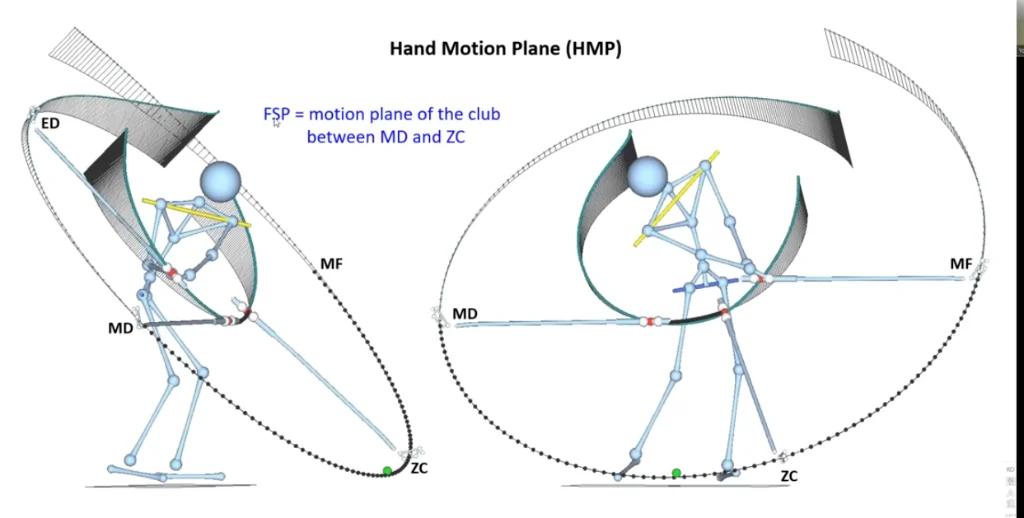
For DIY club makers, independent fitters, and high-handicap players trying to build clubs that actually match their swing, the gap between instruction concepts and fitting decisions is where most projects either succeed or quietly underperform. A player can read everything ever written about swing mechanics and still build a set of clubs that fights against their natural motion. Conversely, a fitter who understands one foundational instruction concept can make significantly better building decisions even before measuring a single static dimension. The single most useful concept to internalize in this category is the golf swing path diagram, the visual representation of how the clubhead moves through impact relative to the intended target line. Reading and applying this diagram correctly transforms how a fitter approaches lie angle, shaft selection, length, head choice, and offset specification, and it is genuinely the difference between a build that works and one that does not.
What the Swing Path Diagram Actually Shows
The swing path diagram visualizes the direction the clubhead is traveling at the moment of impact. The target line runs straight from the ball toward the intended target. The clubhead’s path through the impact zone can be square to that line, traveling from inside the line to outside it (in-to-out), or traveling from outside the line to inside it (out-to-in).
Each of these paths produces predictable ball flight tendencies when combined with the clubface angle at impact. An in-to-out path with a square face produces a draw or push depending on the exact face angle. An out-to-in path with a square face produces a fade or pull. A square path with a square face produces a straight shot, the rare and elusive ideal.
Most amateur golfers do not have square swing paths. The dominant amateur tendency is out-to-in, which combined with an open face at impact produces the classic slice that defines so much of the recreational game. Understanding which way a particular player’s path tends to swing is the starting point for almost every fitting decision that follows.
Why Path Matters for Club Specs
The swing path diagram becomes a fitting tool when you connect path tendencies to specific equipment specifications.
Lie angle. A player with a steep, out-to-in path often presents the club with an effectively upright lie at impact. Building or adjusting clubs to a flatter lie can compensate, while building upright for this player typically makes the slice tendency worse.
Length. Longer clubs encourage flatter, more rotational swing planes. Shorter clubs encourage steeper, more vertical paths. Matching club length to the player’s natural movement preference, rather than to a generic chart, produces more consistent contact and ball flight.
Shaft flex and weight. A shaft too stiff for the player’s swing speed often encourages compensatory motions that distort path. A shaft too flexible produces inconsistent face control. Matching shaft flex and weight to actual delivery characteristics, rather than to swing speed alone, requires understanding how the player generates their path.
Shaft kick point and torque. These specifications affect how the clubhead is released through impact, which directly influences both path and face angle at the moment of contact.
Head design and offset. Offset heads encourage a square or closed face at impact, which can help an out-to-in path player reduce slice tendency. Minimal-offset heads suit players whose paths and face control are already producing reliable contact and shape.
Reading a Player’s Path Without a Launch Monitor
For independent fitters working without expensive launch monitor data, several practical signals help diagnose path tendencies.
Divot direction. Divots that point left of the target line for a right-handed player typically indicate an out-to-in path. Divots pointing right of the target line indicate an in-to-out path. Divots pointing directly at the target indicate a relatively square path.
Habitual ball flight. A player who consistently slices the ball is almost always swinging out-to-in. A player who consistently hooks the ball is generally swinging in-to-out. Push-fades and pull-draws indicate path-face combinations that map to specific swing patterns.
Wear patterns on existing clubs. Where the face shows wear and where the sole shows turf marks both provide information about how the player delivers the club, which connects directly to path.
Posture and setup. Address position influences path. Players standing too far from the ball or with overly bent posture often produce out-to-in paths. Players standing too close or too upright often produce in-to-out paths.
For DIY builders working on their own clubs, a brief honest assessment of these factors produces a useful starting hypothesis about path tendencies that can guide initial spec choices.
Building Clubs That Match the Player
The practical application of all this is a fitting and building philosophy that starts with the player’s actual delivery, not with a generic spec chart. A high-handicap player with a strong out-to-in tendency may benefit from flatter lie, slightly longer length with the right shaft to encourage a flatter plane, an offset head, and a shaft profile that supports proper release timing. A lower-handicap player with a more neutral path needs a different approach.
The key insight is that the right specs are not the ones the box recommends. They are the ones that match how the player actually moves.
Sourcing Components for Path-Aware Builds
For DIY builders and independent fitters putting these principles into practice, sourcing the right components at fair prices is essential to keeping the fitting process accessible. Hireko Golf offers a deep catalog of clubheads, shafts, grips, and complete component selections suited for custom builds across the full range of player profiles, supporting fitters and DIY builders who want to match their work to actual swing characteristics rather than to off-the-rack assumptions. The combination of swing path awareness and quality component access is what separates a thoughtful build from a guess, and the difference shows up in every shot the player takes once the clubs are in the bag.
