


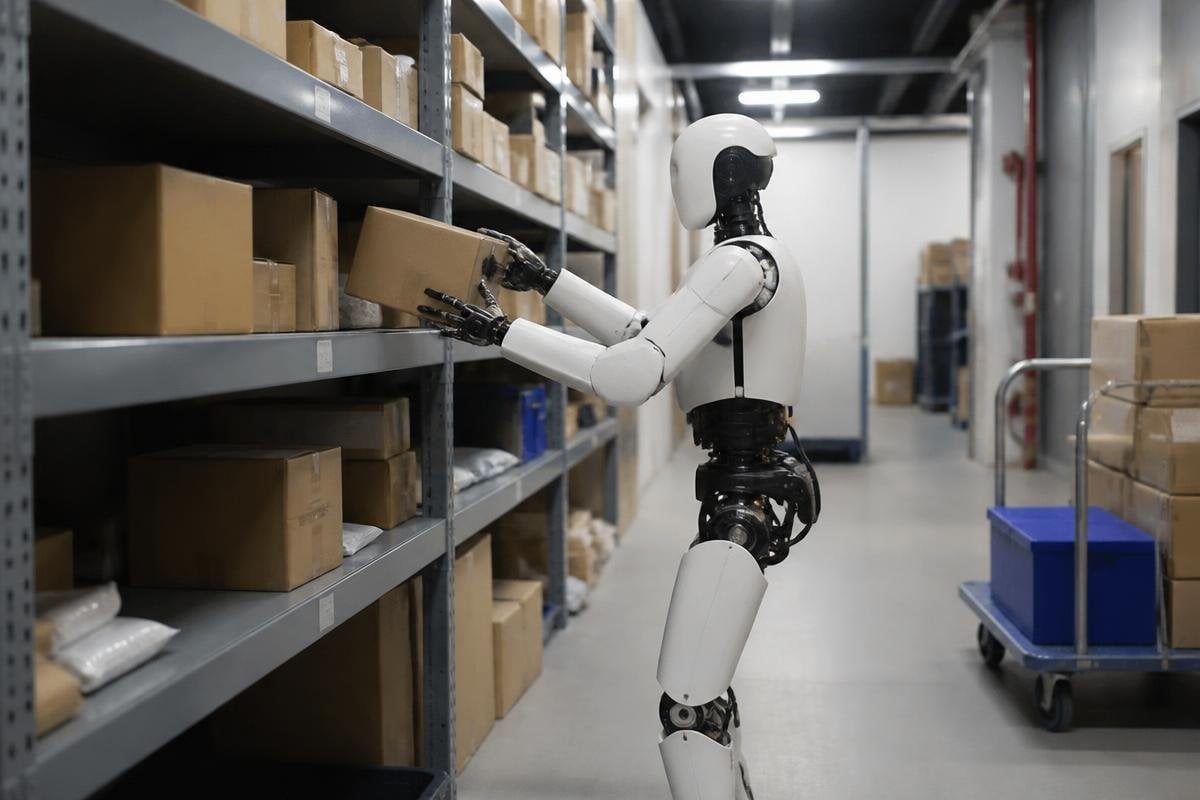
Humanoid robots become useful at a lower price when their full cost fits the work, service, charging, and safety needs around them. The first effect would likely appear in a few repeatable tasks, not across an entire factory.
- Early jobs will favor repeatable movement and simple handoffs.
- The buyer will pay for uptime, training, repairs, and supervision.
- Safety checks will decide where a humanoid can work.
The first jobs would be narrow
A robot with two arms and a human-sized body could work in places built for people. That matters when a site already has stairs, shelves, carts, doors, and tools that would be costly to replace for a special machine.
The work still needs a clear shape. Moving empty bins, carrying a part between two fixed stations, feeding a machine, or sorting known objects are easier starting points than tasks that change every few seconds.
To do that work, the robot would need cameras to see objects, force sensors to feel contact, and software that plans each hand movement. Those parts connect perception to action. If one fails, the task may stop even when the robot’s arms and legs are strong enough.
A lower price won’t remove the hard costs
The purchase price gets attention because it is easy to compare. A factory manager also has to count the charging system, spare parts, software access, worker training, safety review, and time spent watching the robot recover from errors.
That last cost may shape the first deployments. A robot that completes a task while a person stays nearby can still reduce labor on a dangerous or tiring job. It may not work well for a task that needs constant correction.
Frequent charging can leave a work cell waiting, while a robot with a smaller task and a fixed charger may keep its schedule more easily. The useful measure is completed work per shift, not walking speed in an empty room.
Safety changes the workplace around it
Humanoid robots move through spaces made for people, so their motion must be easy to predict. A worker needs a clear way to stop the robot, see what it is doing, and reach the emergency stop without stepping into danger.
The robot also needs limits for speed, force, and reach. A hand that can lift a box may still be unsafe near a person if the control system reacts too late.
Those limits will shape the work zone, the robot’s allowed tasks, and the training each worker receives. This is where broad demos lose value. A short clip can show a successful lift. It can’t show how often the robot drops the item, how long a restart takes, or who fixes the system after a fault.
A low purchase price won’t decide staffing on its own. Failure rates and repair time will shape the count, along with the human handoffs each task needs. Reporting on humanoid robot deployments lets you compare those details with company claims before the job list changes.
The job list will shift before headcount does
At first, a cheaper humanoid may take over tasks that are hard to fill, uncomfortable, or spread across several work areas. The people already doing those jobs won’t vanish from the process. Their work may move toward loading, checking, training, recovery, and repair.
That shift changes the skills a site needs. A technician may spend less time repeating a lift and more time checking gripper wear, reading fault logs, or changing a task plan. The work remains physical, but the person controls more of the system.
I’d wait for proof from long shifts before treating a low sticker price as a buying reason.
A buying check for the first deployment
Use these questions before a humanoid enters a live work area:
- Name one task: Can the job be described with a fixed start, finish, object, and handoff?
- Count the recovery work: Who clears a dropped part, blocked path, or failed grasp?
- Measure the shift: How many completed cycles matter, and how often can charging stop the work?
- Set the safety boundary: Where can people stand, and how can they stop the robot?
- Price the support: What do training, software, spare parts, and service add each year?
- Choose a fallback: Can a person take over without changing the whole station?
A humanoid becomes affordable when it can finish useful work with limited supervision and a clear repair plan. The next proof will come from ordinary shifts, where the record includes every stop, restart, charge, and human intervention.
