


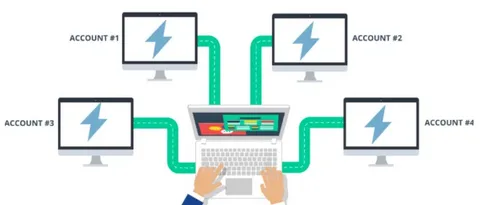
As digital businesses expand across borders, platforms, and audiences, one operational challenge keeps resurfacing: managing multiple accounts efficiently without triggering platform restrictions. What once could be handled with a few browser tabs has now evolved into a complex system requiring structure, consistency, and technical awareness.
Behind the scenes, a new layer of tools is shaping how professionals handle this complexity—tools designed not just for browsing, but for managing environments.
The Operational Bottleneck of Multi-Account Workflows
Running multiple accounts sounds simple in theory. In practice, it often leads to:
- Constant switching between logins
- Confusion over account ownership and access
- Increased risk of account flags due to overlapping activity
- Inefficient manual processes across platforms
For teams managing advertising campaigns, eCommerce stores, or social media pages, these inefficiencies quickly compound. What starts as a manageable workflow can turn into operational clutter.
From Tabs to Structured Environments
Traditional browsers were never designed for structured multi-account workflows. Opening multiple tabs or even separate profiles still leaves traces of shared data points, such as system-level fingerprints or device configurations.
Modern tools like 比特浏览器 approach this problem differently. Instead of focusing on tabs or profiles, they create isolated browser environments that function independently from one another.
Each environment can be thought of as a self-contained workspace, tailored to a specific account or task.
What Makes an Environment “Independent”?
An independent browser environment goes beyond clearing cookies or using incognito mode. It includes:
- Unique browser fingerprint parameters
- Dedicated proxy configurations
- Separate storage for session data
- Customizable system attributes like language and time zone
This level of separation ensures that activities in one environment do not influence or expose patterns in another.
For businesses handling multiple regions or platforms, this becomes particularly relevant when trying to maintain consistency in how accounts appear online.
Managing Complexity Through Centralization
One of the overlooked challenges in multi-account setups is not just separation, but organization.
Without a structured system, teams often rely on spreadsheets, shared documents, or memory to track account details. This increases the likelihood of:
- Access errors
- Miscommunication between team members
- Inconsistent workflows
Environment-based browser systems introduce centralized dashboards where accounts can be grouped, labeled, and accessed in a controlled manner. Permissions can be assigned, and activities can be standardized across the team.
This shift from scattered management to centralized control significantly reduces operational friction.
Automation as a Scaling Tool
As the number of accounts grows, manual processes become unsustainable. Tasks such as:
- Logging into multiple dashboards
- Updating listings or campaigns
- Performing repetitive actions across accounts
can consume hours of daily effort.
Automation features—often integrated into these systems—allow users to convert repetitive actions into repeatable workflows. This may include:
- Script-based execution
- Visual automation builders
- Scheduled task triggers
The benefit is not just time-saving, but also consistency. Automated processes reduce variation in behavior, which can be important when working within platform guidelines.
Synchronization: Working Across Accounts Simultaneously
Another emerging feature in this space is synchronized control. Instead of managing accounts one by one, users can:
- Execute the same action across multiple environments
- Mirror mouse and keyboard inputs
- Maintain uniform browsing behavior across sessions
This is particularly useful in scenarios like campaign launches, bulk updates, or testing across multiple accounts.
It transforms multi-account management from a sequential process into a parallel one.
The Role of APIs in Workflow Integration
For more advanced use cases, local APIs are becoming an important component. They allow browser environments to interact with external systems, enabling:
- Integration with internal tools
- Programmatic control of browser actions
- Custom automation pipelines
This opens up possibilities for businesses to build tailored workflows that align with their specific operational needs.
Rethinking Efficiency in Digital Operations
Efficiency in digital workflows is often associated with speed. However, in multi-account environments, it’s equally about structure and predictability.
Using tools designed for environment isolation and management encourages a more disciplined approach:
- Each account has a defined environment
- Each action follows a consistent pattern
- Each team member operates within controlled parameters
This reduces randomness, which is often the root cause of operational issues.
Looking Ahead
As digital ecosystems continue to evolve, the tools supporting them will also become more specialized. Browser environment management is one such evolution—quietly becoming a foundational layer for businesses that operate at scale.
Rather than treating multi-account management as a workaround, it is increasingly being approached as a system that requires its own infrastructure.
Understanding and adopting this perspective can make the difference between reactive operations and scalable growth.
