


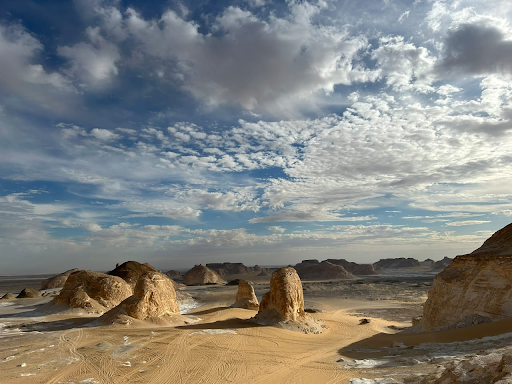
Egypt’s deserts have shaped civilizations, inspired legends, and continue to captivate travelers with their otherworldly beauty. Covering approximately 96% of the country’s total landmass, these vast arid expanses are far more than barren wastelands; they are living museums of geological wonders, ancient history, and remarkable biodiversity that has adapted to one of Earth’s harshest environments.
The Geography of Egypt’s Desert Realm
Egypt’s desert landscape is primarily divided into two major regions: the Western Desert and the Eastern Desert, both part of the greater Sahara system. The Western Desert, which comprises roughly two-thirds of Egypt’s territory, stretches westward from the Nile Valley to Libya. This immense region contains several distinct features, including the otherworldly White Desert with its chalk rock formations, the Great Sand Sea with its towering dunes, and five major oases that have served as vital lifelines for millennia.
The Eastern Desert lies between the Nile and the Red Sea coast, characterized by rugged mountains, deep wadis, and ancient trade routes that once connected the Nile Valley with the Red Sea ports. The geology here differs significantly from its western counterpart, featuring igneous and metamorphic rocks that have yielded precious minerals and gemstones throughout history.
Between these two major deserts runs the Nile River, a thin ribbon of life that has sustained Egyptian civilization for over 5,000 years. The stark contrast between the lush Nile Valley and the surrounding desert creates one of the most dramatic geographical boundaries on Earth, visible even from space.
Desert Ecosystems and Wildlife
Despite the harsh conditions, Egypt’s deserts host surprisingly diverse ecosystems. Specialized flora and fauna have evolved remarkable adaptations to survive extreme temperatures, scarce water, and intense solar radiation. Desert foxes, gazelles, sand cats, and various reptile species navigate these landscapes with evolutionary precision. The endangered Nubian ibex still roams the mountainous regions of the Eastern Desert, while migrating birds use desert oases as crucial stopover points along their transcontinental journeys.
Plant life, though sparse, demonstrates incredible resilience. Acacia trees dot the landscape where underground water sources permit, their deep root systems accessing moisture far below the surface. After rare rainfall events, the desert briefly transforms as dormant seeds burst into life, carpeting the sand with ephemeral wildflowers in a phenomenon that occurs only once every several years.
Historical Significance
The deserts of Egypt are repositories of human history spanning millennia. Ancient Egyptians viewed the desert as the realm of Set, the god of chaos and disorder, contrasting sharply with the fertile “Black Land” of the Nile Valley. Yet these apparently inhospitable regions played crucial roles in Egyptian civilization.
The Western Desert oases Siwa, Bahariya, Farafra, Dakhla, and Kharga served as vital trading posts along caravan routes connecting Egypt with sub-Saharan Africa and the Mediterranean world. Siwa Oasis, perhaps the most famous, was home to the Oracle of Amun, consulted by Alexander the Great himself in 331 BCE. These settlements developed unique cultures, languages, and agricultural systems that persist today.
The Eastern Desert’s mountains yielded valuable resources: gold, copper, and precious stones that adorned pharaonic monuments and tombs. Ancient quarries still bear the marks of workers who extracted granite, porphyry, and other building materials used in temples and pyramids. Roman-era sites dot the landscape, evidence of continued exploitation of desert resources well into the classical period.
Natural Wonders and Geological Marvels
Egypt’s deserts showcase geological phenomena found nowhere else on Earth. The White Desert, near Farafra Oasis, features surreal chalk formations sculpted by wind erosion into mushroom-like shapes and abstract sculptures. These formations glow brilliantly white under the sun and take on ethereal qualities during sunrise and sunset.
The Black Desert, formed from volcanic activity millions of years ago, presents a landscape of dark volcanic rocks and hills that contrast dramatically with the surrounding golden sands. Crystal Mountain, where calcite crystals sparkle in the sunlight, and the Cave of Swimmers, containing prehistoric rock art depicting people swimming, add to the region’s mystique.
The Great Sand Sea, spanning the border with Libya, contains some of the world’s longest dune chains, extending over 100 kilometers. These massive formations migrate slowly but constantly, shaped by prevailing winds into crescents, stars, and linear patterns that testify to the desert’s dynamic nature.
Modern Desert Life and Tourism
Today, Egypt’s deserts support small but resilient communities that maintain traditional lifestyles while adapting to modern challenges. Bedouin tribes continue semi-nomadic existence in certain regions, their knowledge of desert survival passed down through generations. Their expertise in navigation, water location, and weather prediction represents an invaluable cultural heritage.
Desert tourism has grown significantly, offering adventurers opportunities to experience these landscapes through safaris, camping expeditions, and cultural exchanges with local communities. Sustainable tourism initiatives aim to balance economic development with environmental preservation, ensuring these fragile ecosystems remain intact for future generations.
The deserts also play crucial roles in Egypt’s modern economy beyond tourism. Solar energy projects harness the abundant sunshine, while ongoing archaeological excavations continue revealing secrets buried for millennia. Plans for agricultural development in desert regions using advanced irrigation techniques represent ambitious efforts to expand Egypt’s habitable land.
Environmental Challenges and Conservation
Climate change poses significant threats to Egypt’s desert ecosystems. Rising temperatures, changing precipitation patterns, and increasing desertification pressure both human communities and wildlife. Groundwater depletion in oases threatens ancient agricultural systems, while unregulated tourism damages fragile formations and disturbs wildlife habitats.
Conservation efforts focus on protecting key areas, managing tourism sustainably, and supporting local communities in maintaining traditional land management practices. Protected areas like the White Desert National Park help preserve unique geological formations and biodiversity, though enforcement and resources remain ongoing challenges.
Research into desert ecology, climate patterns, and sustainable development continues advancing our understanding of these complex environments. International cooperation brings expertise and funding to conservation projects, recognizing that Egypt’s deserts represent global heritage worthy of protection.
Conclusion
Desert Egypt encompasses far more than empty sand and scorching heat. These landscapes contain layers of history, ecology, geology, and culture that reveal themselves to those willing to venture beyond the Nile Valley. From ancient oases that sustained civilizations to natural wonders that defy imagination, Egypt’s deserts offer profound connections to Earth’s past and important lessons for our future. As climate change and development pressures intensify, preserving these remarkable environments becomes increasingly critical, ensuring that future generations can experience the majesty and mystery of Desert Egypt.
Frequently Asked Questions
What percentage of Egypt is desert? Approximately 96% of Egypt consists of desert landscapes, with the remaining 4% comprising the Nile Valley and Delta where the vast majority of the population lives.
Can you visit Egypt’s deserts safely? Yes, desert tourism is well-established in Egypt, though visitors should travel with experienced guides, bring adequate supplies, and inform others of their plans. Organized tours to areas like the White Desert and Siwa Oasis operate regularly with safety protocols.
What is the best time to visit Egyptian deserts? The optimal period is October through April when temperatures are more moderate. Summer months (May-September) bring extreme heat that can exceed 45°C (113°F), making outdoor activities dangerous.
Are there any permanent settlements in Egypt’s deserts? Yes, the five major oases (Siwa, Bahariya, Farafra, Dakhla, and Kharga) support permanent populations that have lived in these areas for thousands of years, practicing agriculture using springs and underground water sources.
What wildlife can be found in Desert Egypt? Despite harsh conditions, the deserts support foxes, gazelles, sand cats, various snake and lizard species, scorpions, and numerous bird species. The Nubian ibex inhabits mountainous regions, though it’s increasingly rare.
Deserts offer profound connections to Earth’s past and important lessons for our future. As climate change and development pressures intensify, preserving these remarkable environments becomes increasingly critical, ensuring that future generations can experience the majesty and mystery of Desert Egypt.
