


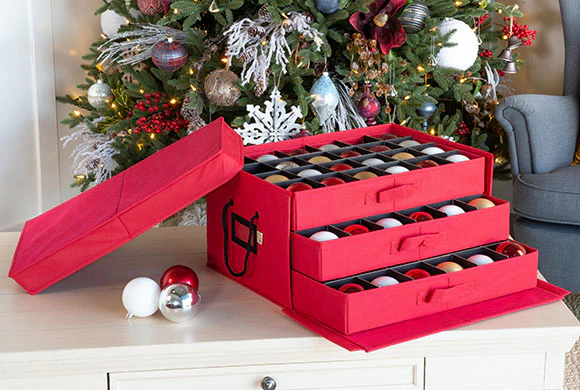
For the dedicated holiday enthusiast, the annual transition from a festive home to a streamlined one is often fraught with a subtle anxiety. The primary concern is rarely the labor of the cleanup, but rather the safety of the artifacts themselves. Many collectors still rely on the “status quo” of holiday organization: tattered cardboard boxes, original retail packaging, or unstructured plastic totes. However, the evolution of seasonal logistics has introduced significant improvements ornament storage box designs, moving away from simple “containment” toward a philosophy of “active preservation.” These modern systems are engineered to address the specific mechanical and environmental threats that lead to the degradation of heirloom glass, delicate ceramics, and hand-painted keepsakes.
The Failure of Traditional Storage Methods
To understand the value of modern improvements, one must first identify the failures of traditional methods. Cardboard is acidic; over years of contact, it can yellow fabric and cause “crazing” in vintage paint. Plastic totes, while waterproof, are “air-traps” that can foster condensation in humid basements or attics, leading to mold or the tarnishing of metallic finishes. Furthermore, unstructured bins allow for “migration”—the movement of items within the box that causes the microscopic friction and high-impact “clinking” responsible for most breakage.
Structural Reinforcements and the “Chassis” Design
The first major improvement in professional-grade storage is the use of a rigid internal chassis. Unlike soft bags that can sag or plastic bins that can crack, modern premium cases utilize reinforced side panels and internal tray systems.
- Telescoping Trays: High-end models often feature trays that can be removed entirely from the box. This allows the decorator to take one tray to the tree at a time, reducing the risk of tripping over a large bin or knocking it over.
- Structural Padded Dividers: Rather than thin cardboard inserts, these boxes use acid-free, padded dividers. These provide a “soft-stop” for ornaments, absorbing the kinetic energy of any external bumps or shifts during transport.
Environmental Shielding: Fabric and Zippers
Modern improvements extend to the “envelope” of the storage unit. High-denier polyester (such as 600D or 1200D) provides a tear-resistant, puncture-proof exterior that plastic cannot match.
- Self-Healing Zippers: One of the most common points of failure in cheap storage is a snagged zipper. Professional units use heavy-duty, self-healing zippers that prevent dust and pests (like silverfish or spiders) from infiltrating the collection.
- Breathability vs. Waterproofing: While a bin must be water-resistant, it must also allow for a degree of air exchange to prevent the aforementioned condensation issues. Advanced fabrics act as a semi-permeable membrane, protecting the interior while maintaining a stable “micro-climate.”
The Ergonomics of the Attic Trek
The “user experience” of holiday cleanup is often ignored by big-box manufacturers. Professional storage units incorporate ergonomic improvements that make the trek to the attic or basement safer. This includes reinforced, dual-stitched handles located on multiple sides of the box, ensuring the weight is distributed evenly. Some models even feature “ID windows,” allowing the homeowner to inventory the contents without breaking the seal, which is vital for those with multi-theme collections.
Investing in Seasonal Longevity
Ultimately, the goal of specialized storage is to stop the cycle of “seasonal loss.” When you lose even one or two cherished ornaments a year to poor storage, the financial and emotional cost far exceeds the price of a quality storage system. By sourcing your organizational tools from a dedicated specialist like 612 Vermont, you are choosing a system built on decades of feedback from collectors and decorators. These improvements turn a chaotic post-holiday chore into a streamlined archival process, ensuring your home’s history remains intact for the next generation.
